
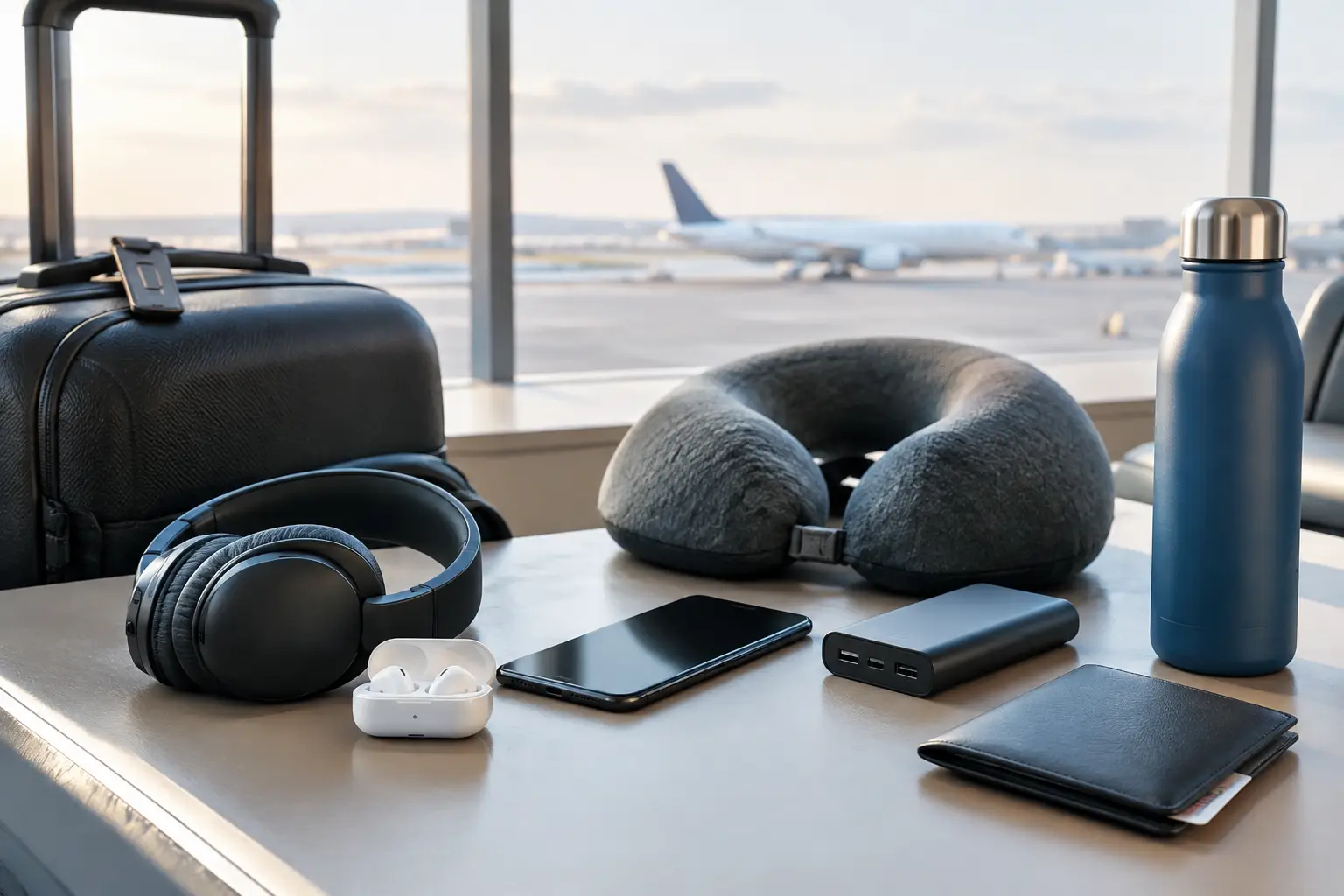
12 Frequent Flyer Gadgets Worth Packing
The worst travel purchases are made at Gate 34, after a delayed flight has turned a sensible person into someone willing to spend £28 on a neck pillow shaped like a giant prawn. The best frequent flyer gadgets do the opposite: they remove small, repeating annoyances without claiming half your cabin bag or needing another charging cable.
For regular travellers, the aim is not to own more gear. It is to build a lean carry-on setup that protects your phone, keeps you powered up, makes sleep more likely and saves you from the usual airport faff. Here is what earns its place, and what is mostly marketing fluff.
Frequent Flyer Gadgets That Solve Real Problems
1. A high-capacity power bank with fast charging
Your phone is boarding pass, map, hotel key, translator, camera and emergency contact point. Letting it reach 3 per cent halfway through a connection is avoidable misery.
Look for a power bank around 10,000mAh to 20,000mAh with USB-C Power Delivery, which can charge a modern phone quickly and, in some cases, give a tablet or small laptop a useful boost. A 10,000mAh model is enough for a long weekend. Go larger if you work while travelling or regularly face long-haul routes and multiple devices.
There is a trade-off: larger batteries are heavier, and airlines have rules. Lithium power banks must normally travel in hand luggage, not checked baggage, and many carriers limit them to 100Wh without prior approval. Check the capacity is clearly printed on the unit before you fly. It saves an awkward conversation at security.
2. A universal travel adaptor with USB-C ports
A basic adaptor only changes the shape of the plug. A good universal adaptor earns its weight by charging several devices from one wall socket – ideally with at least one USB-C port alongside USB-A ports.
This is especially useful in older hotels, where the one available socket may sit behind a bedside table or nowhere near the bed. It will not convert voltage, though. Most phone, camera and laptop chargers handle 100-240V automatically, but heated styling tools and certain electric toothbrushes may not. Read the small print rather than finding out through a burning smell in Barcelona.
3. A compact multi-port charger
An adaptor is only half the equation. Pair it with a compact charger that has enough power for your phone, watch and laptop, and you can leave several bulky plugs at home.
Gallium nitride, usually labelled GaN, chargers are smaller and run cooler than older charging bricks. A 65W model suits many travellers with a USB-C laptop; a 30W to 45W version is usually plenty for phones, tablets and cameras. Before buying, check your laptop’s required wattage. A cheap low-power charger can keep a laptop alive, but may charge painfully slowly or not at all while you are using it.
4. Proper noise-cancelling headphones
This is one of the few frequent flyer gadgets that can genuinely improve a flight, particularly if you are trying to sleep, work or preserve your patience near a crying baby. Active noise cancellation does not remove every sound, but it is excellent at reducing the steady drone of engines.
Over-ear headphones normally offer better comfort and stronger noise reduction than earbuds on long flights. Earbuds win if cabin-bag space is tight or you sleep on your side. Try before you commit if possible: the best-reviewed pair is no bargain if it gives you a headache after 90 minutes.
Do not rely on Bluetooth alone. Aircraft entertainment systems often still use a 3.5mm socket, sometimes with a two-pin airline fitting. A small Bluetooth audio transmitter can bridge that gap, but it is another item to charge. For many people, a simple wired cable and adaptor is the less glamorous, more reliable answer.
5. A Bluetooth tracker for checked luggage
A tracker tucked inside your suitcase will not stop an airline misrouting it, but it can tell you whether your bag made it onto the plane, is lingering at the departure airport or is already circling the carousel while you are in passport control.
That knowledge matters when reporting a delayed bag. Instead of saying it has disappeared somewhere, you can give the airline a clearer last known location. Choose a tracker compatible with your phone, replace its battery before a major trip if needed, and keep the app updated.
Think of it as reassurance and evidence, not a magic recovery service. Airport signals can be patchy, location updates are not always instant, and airport staff still control access to restricted areas.
6. A slim cable organiser
Cables have a strange ability to multiply in a rucksack. A flat organiser or small zip pouch prevents the familiar hotel-room hunt for a charging lead that has buried itself beneath socks and receipts.
Keep it ruthlessly simple: one short USB-C cable, one longer cable for awkward sockets, any genuinely necessary proprietary lead, a plug adaptor and a spare SIM tool if you use one. A cable organiser is not exciting, but it means you can unpack in 20 seconds rather than emptying your entire bag onto the airport lounge floor.
7. An e-reader
An e-reader is far more useful than a tablet for travellers who read regularly. It is lighter, the battery lasts for days or weeks, and it remains readable in bright sun by a pool, on a train platform or during a power cut in a budget guesthouse.
Load it before leaving home. Airport Wi-Fi is often slow, hotel internet can be unreliable, and buying a book abroad is an oddly poor use of holiday time. If you prefer guidebooks, save offline copies or screenshots of key pages too. Your carefully curated restaurant list is no use when the signal drops in a narrow lane.
8. A phone stand that folds flat
A small folding phone stand is the sort of gadget that sounds unnecessary until you use one. It makes video calls from hotel rooms less awkward, holds your phone upright during a delayed departure, and turns a tray table into a workable screen for downloaded films.
Choose one with a wide base and adjustable angle. The ultra-cheap credit-card-sized versions are fine for a phone, but can wobble with a larger handset or a protective case. It should fold flat enough to live in your cable pouch, otherwise it will stay in a drawer at home.
9. A refillable water bottle with a built-in filter
Buying bottled water at every airport and sightseeing stop is expensive, wasteful and surprisingly annoying. A refillable bottle pays for itself quickly on frequent trips, particularly if you usually fly from UK airports where empty bottles can go through security and be filled airside.
A filter bottle is useful where tap-water safety is uncertain, but be realistic about what it does. Different filters deal with different contaminants, and most are not intended to make every water source safe. Check the manufacturer’s claims, replace filters on schedule, and use sealed water where local advice says you should.
10. A compact digital luggage scale
If you tend to fly with low-cost airlines, a luggage scale can save money and a last-minute repacking performance at check-in. It is particularly handy on multi-stop trips, when souvenirs, wet clothes and a new pair of trainers somehow add three kilos to a bag.
The limitation is obvious: it only helps if you use it before reaching the airport. Weigh your cabin bag at the hotel, then allow a little margin. Airline scales are not always identical, and some carriers care as much about bag dimensions as weight.
11. A small door alarm or portable door lock
For solo travellers staying in budget accommodation, a simple portable door lock or door-stop alarm can offer extra peace of mind. It is not a replacement for choosing accommodation carefully, reading recent reviews or trusting your instincts. It is an additional layer when you are alone in an unfamiliar room.
Check compatibility before relying on one. Some devices will not fit certain door frames, and a noisy alarm can be a nuisance if you set it off by accident at 2am. Practise fitting it at home, where nobody will be woken up and no one is waiting outside the door.
12. A tiny torch, not your phone torch
A pocket torch is useful when you arrive at a poorly lit rural stay, need to find something under an aircraft seat, or walk back from dinner on a dark road. Your phone has a torch, of course, but draining the battery you need for maps or a taxi is not ideal.
Pick a rechargeable model with a lockout mode, so it cannot switch on in your bag. Avoid tactical-looking oversized torches. You are trying to find a hostel keyhole, not lead a search party across the Highlands.
What to Leave Behind
The gadget test is simple: will you use it on at least three trips a year, and does it solve a problem your phone or a basic item cannot solve? If the answer is no, leave it.
Most travellers can skip bulky travel pillows unless they already know a particular design works for them. Mini fans, luggage scooters, UV phone sanitisers and complicated all-in-one survival tools usually create more clutter than comfort. The same goes for cheap packing cubes with zips that fail on trip two. Organisation is useful; hauling a mini branch of Currys around Europe is not.
A good setup evolves with your travel style. A one-bag city-break traveller might value a tracker, power bank and compact charger above everything else. Someone taking overnight flights for work may put headphones and an e-reader first. Test your kit on a short break, notice what you actually reach for, then cut the rest. The smartest travel gadget is often the one that stays quietly in your bag until the exact moment it saves your day.