
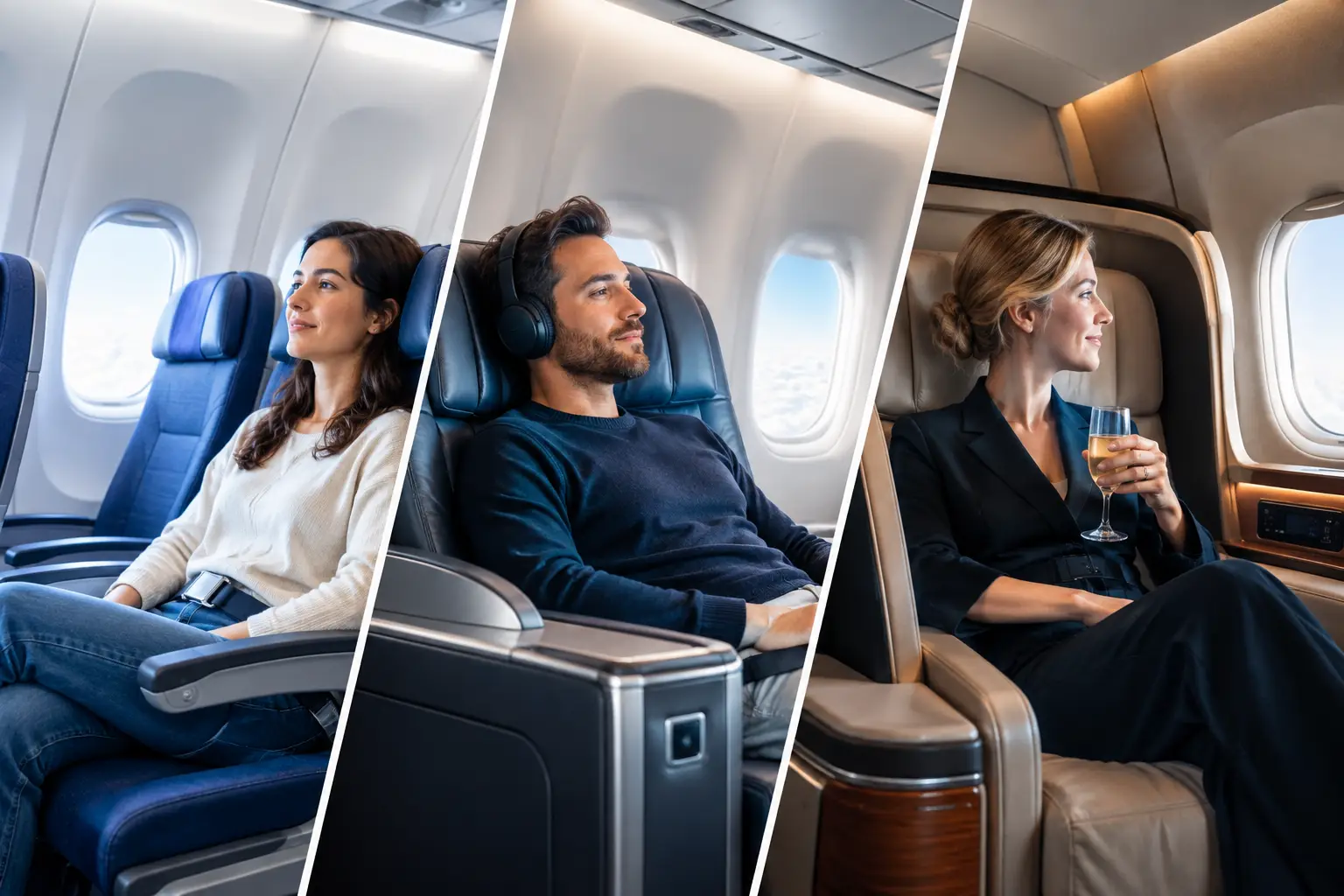
Flight Classes Explained: Which Seat Is Worth It?
A £40 fare difference can look like a bargain until you realise it buys no checked bag, no seat choice and a 12-hour flight with your knees pressed into the seat ahead. Flight classes are not just about champagne and posh airport lounges. They determine your space, sleep, flexibility and, sometimes, whether a long-haul trip starts brilliantly or badly.
The catch is that airlines use confusing labels, while booking sites often put the cheapest price front and centre. A sensible choice depends on the route, the airline, your body, your budget and what you plan to do when you land. There is no prize for flying business class to Barcelona if it wipes out your food budget, but there is also no virtue in saving £150 on a red-eye to Bangkok if you lose two days recovering.
What flight classes actually mean
Most airlines sell four broad cabin classes: economy, premium economy, business and first class. These are the physical cabins on the aircraft, although the experience can vary wildly between carriers. Economy on a newer wide-body aircraft may be perfectly tolerable; economy on an older plane with tight seating can feel like a very long lesson in patience.
Then there are fare types within each cabin. An airline might sell Economy Light, Economy Basic, Economy Standard and Economy Flex. You could be seated in exactly the same cabin, but get different baggage allowances, refund rules, points and seat-selection options. This is where many apparently cheap fares stop being cheap.
Before comparing prices, check both the cabin and the fare conditions. For UK travellers, that means looking closely at whether cabin baggage is included, whether a checked suitcase costs extra, and what happens if your plans change. A £35 short-haul fare can quickly become £90 once you add a bag, a sensible seat and priority boarding.
Economy class: the smart default for most trips
Economy is where most of us fly, and for short-haul European breaks it is usually the right answer. The seats are broadly similar whether you choose a low-cost airline or a legacy carrier, though the extras can be very different. You may get a small recline, a tray table, minimal legroom and food only if you pay for it.
For a two-hour flight to Lisbon, Prague or the Algarve, focus less on cabin class and more on the total cost and flight times. A 6am departure that requires a £70 airport taxi is not automatically better value than a mid-morning flight that costs £25 more. Equally, paying for extra legroom can be worthwhile if you are tall, travelling with a partner who needs space, or trying to avoid arriving at a city break already in a foul mood.
Long-haul economy needs more thought. Seat pitch, the distance between your seat and the one in front, often matters more than the headline airline brand. Look at the aircraft layout if you can. A 3-3-3 configuration on a wide-body plane tends to feel less cramped than 3-4-3, and a two-seat section at the side is often ideal for couples who would rather not gamble on a stranger occupying the middle.
Economy works well when the flight is daytime, under about eight hours, or when your holiday budget is better spent on accommodation and experiences. It is also the sensible route when you are backpacking, hopping between destinations or travelling with only hand luggage.
Premium economy: better, but not business class
Premium economy is the cabin people misunderstand most. It is not business class at a discount. Think of it as economy with meaningful breathing room: a wider seat, more legroom, a deeper recline, better food and drink, and sometimes priority check-in or extra baggage.
On an overnight flight, that extra space can make a genuine difference. You are unlikely to arrive fully rested, but you may arrive functional enough to check into your hotel, eat something decent and explore without needing a four-hour nap. For a honeymoon, a once-a-year big trip or a flight where you need to work soon after landing, that can be money well spent.
The value depends heavily on the price gap. If premium economy costs £150 to £300 more each way than economy on a long route, it can be a strong upgrade. If it is double the economy fare, pause. That extra spend might cover several nights in a better guesthouse, a food tour and your airport transfers.
Also check the seat rather than trusting the cabin name. Some airlines offer an excellent product with a proper footrest and generous recline; others offer a slightly roomier economy seat dressed up with a nicer blanket.
Business class: pay for sleep, time and flexibility
Business class becomes compelling when the seat turns into a flat bed. On a long-haul overnight route, proper sleep is the biggest upgrade on offer. Lounge access, better meals and priority queues are pleasant, but the ability to arrive in New York, Singapore or Cape Town without feeling wrecked is what you are really paying for.
It can make sense for travellers with limited time. If you have five days in Japan and land in Tokyo after a 14-hour journey, business class may effectively buy back part of your first day. It can also be worth considering when a sale brings the fare close to premium economy, or when using points makes the cash difference manageable.
But business class is not always a flat bed. On many short-haul European services, it is simply an economy seat with the middle seat blocked, better food and lounge access. That may be useful if you value a calm airport experience or need flexible tickets, but it is rarely worth a huge premium for a two-hour flight.
For couples, there is another detail worth checking: the layout. Some business cabins have seats in a staggered pattern with a divider between you. Others offer paired seats, which are much better if sharing the flight experience matters to you. A flashy fare is no substitute for looking at the actual cabin.
First class: extraordinary, rarely rational
International first class can include private suites, proper dining, high-end lounges and ground transfers. It is an experience in its own right, and if you have the points, money or a special occasion, there is nothing wrong with choosing it.
For most independent travellers, though, it is not where the best value lies. The difference between economy and business is often transformational. The jump from business to first is usually about privacy, luxury and bragging rights. Those are valid wants, but they are wants, not planning essentials.
How to choose between flight classes without overspending
Start with the flight itself. A daytime flight from London to Rome does not need the same strategy as an overnight flight from Manchester to Dubai. Consider departure time, total journey length, aircraft type and whether you have a connection. Two slightly longer flights with comfortable timings may beat one direct flight that leaves you shattered.
Then put a realistic price on the upgrade. Do not compare the cheapest economy fare with the headline business fare. Compare like for like once you have added the bags, seat selection and flexibility you actually need. If you are travelling with a checked suitcase, a basic fare with add-ons may cost almost as much as a better economy ticket.
Be honest about your priorities. If you sleep anywhere and have two weeks to relax after arrival, economy might be all you need. If you are tall, anxious about flying, travelling after a difficult period, or heading straight into a demanding itinerary, more space has a practical value beyond comfort.
A few details deserve a final check before you pay:
- Is the flight operated by the airline selling the ticket, or a partner with a different cabin?
- Does the fare include the baggage and seat choice you will actually use?
- Is the business-class seat lie-flat, angled-flat or just a larger recliner?
- Are there better-value upgrade offers available after booking or at online check-in?
Cheap upgrades at check-in do happen, but do not build your whole plan around one. If a better cabin is essential to you, book it. If it is a nice-to-have, set a maximum price and see what appears later.
The best flight class is the one that gets you to your holiday with enough money, energy and patience left to enjoy it. Spend more where it changes the trip, save where it does not, and never let a shiny cabin distract you from the far more useful question: what will this choice let you do once you land?