
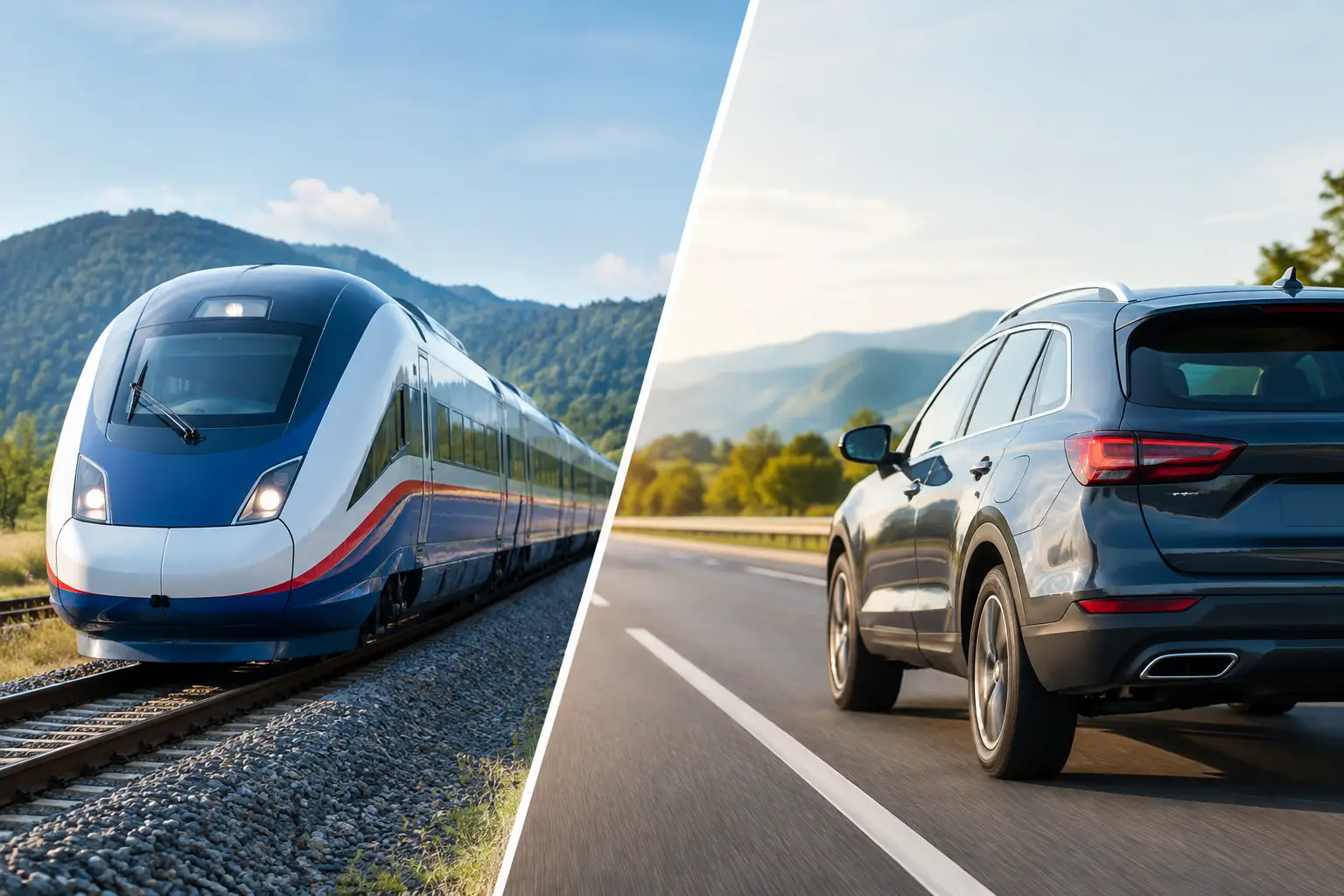
Rail Versus Car: Which Is Better for Your Trip?
You can find a £25 train ticket to Edinburgh or a cheap hire car that looks like a bargain, then lose an hour trying to work out which is actually cheaper. Rail versus car is rarely a simple price comparison. One gives you a seat, a view and licence to ignore the journey. The other gives you a boot, a detour and the freedom to change plans at 4pm.
The better choice comes down to the trip you are taking, not the transport you usually prefer. A weekend in a walkable city and a week chasing beaches, villages and trailheads are completely different jobs. Here is how to choose without convincing yourself that the cheapest-looking option must be the right one.
Rail versus car: start with the real journey time
Train timetables can look deceptively neat. A London to York service may take around two hours, but add getting to the station, arriving early enough not to panic, and reaching your hotel at the other end. It is still often quicker than driving, particularly when traffic, fuel stops and city-centre parking enter the picture.
Cars win where the journey has multiple moving parts. If you are staying in a cottage in Northumberland, hiking in the Lake District or hopping between small towns in Portugal, the train may get you close but not close enough. Buses can fill the gap, yet they can also turn a short transfer into an awkward two-hour wait with your rucksack at your feet.
Think door to door, not station to station. Check where you are sleeping, what time you land, whether your accommodation has parking and how you will get around once you arrive. A hire car is not freedom if it spends three days outside your hotel while you walk everywhere.
There is also the energy cost. On a train, you can read, work, nap or stare out of the window with a supermarket sandwich. After four hours behind the wheel, the person driving may not be keen to hunt down a late dinner or start a hike at sunrise. For couples, this matters more than people admit. The holiday starts faster when neither of you is quietly irritated by motorway traffic.
The cost comparison most travellers get wrong
Rail fares are easy to see upfront. Car costs are spread around, which makes them easier to underestimate. For a proper comparison, include fuel, hire cost, insurance excess cover if you choose it, parking, tolls, congestion charges and any extra driver fee. If you are taking your own car, factor in wear, servicing and the fact that a long drive is not magically free because you already own the vehicle.
For one person travelling between big cities, rail is often the stronger value choice, especially if tickets are booked ahead. Advance fares, off-peak travel and railcards can cut the bill sharply. A railcard can pay for itself surprisingly quickly if you are making a few longer journeys over the year.
For two people, the calculation gets closer. For three or four, a car can become the cheaper option, particularly outside the UK’s major cities. That is before you consider luggage: one checked bag on a flight can cost enough to make a compact hire car look less outrageous.
European trips need an extra layer of maths. Fast trains between places such as Paris, Amsterdam, Milan and Barcelona can be excellent, but the lowest fares disappear early. Meanwhile, low-cost car hire deals can hide hefty deposits, airport collection charges and expensive fuel policies. Read the terms before treating either headline price as fact.
When rail is genuinely the better holiday choice
Rail is at its best when the destination is compact, the route is direct and you want to spend your time doing things rather than managing logistics. It suits city breaks especially well. You arrive near the centre, skip airport transfer costs and avoid the headache of driving somewhere with restricted zones, narrow streets and parking priced like a second hotel room.
It is also a strong option for solo travellers. A train removes the worry of driving an unfamiliar vehicle on the wrong side of the road, finding a petrol station late at night or walking back to a remote car park alone. You still need normal awareness at stations, particularly with bags and phones, but the journey is usually simpler to manage.
Rail travel can make a multi-stop route feel more like a holiday and less like a mission. You can spend two nights in one place, catch a morning train, have lunch in the next city and carry on. No return-to-the-same-airport problem, no debate about whose turn it is to drive, and no need to navigate an unfamiliar ring road after dark.
The downsides are real. Strikes, cancellations and late-running services can unravel a tightly planned itinerary. Luggage space can be limited, rural connections may be thin, and a cheap ticket is less useful if it ties you to a 06:12 departure. Build in slack, especially for an international connection or a flight home.
When a car gives you more than a train can
Choose a car when the destination itself is the point. The Scottish Highlands, the Welsh coast, the Cotswolds, Iceland’s quieter corners and much of rural Spain reward the ability to stop when something catches your eye. A pub lunch in a village, an empty beach, a farm shop or a trailhead should not require a spreadsheet of local bus times.
A car is also practical for travel with bulky gear. Camping equipment, climbing ropes, surfboards, ski kit and a week’s worth of food are possible by rail, but they make every platform change more annoying. Families may find driving easier too, though a long journey with tired children can turn that convenience into a very loud test of character.
The catch is that driving abroad takes attention. Learn the local road rules before you leave, including speed limits, toll systems, low-emission zones and compulsory equipment. In some countries, the annoying part is not the driving but the parking. A beautiful old town may be exactly where you do not want to take a car.
If you hire, photograph the vehicle inside and out before leaving the car park. Check the fuel policy, mileage limit, cross-border rules and what happens if you get a puncture. These details are boring until they cost you £200.
A smarter answer: use both
The best rail versus car decision is often not an either-or decision. Take the train to a city, then hire a car for the rural section. Fly into one airport, travel overland, and return from another. Spend the first two nights in a city without a vehicle, then collect one only when you are ready to leave.
This approach avoids paying for a car while it sits unused and reduces the pressure to drive on arrival day. It can also make a couples’ trip smoother: one person may love planning scenic routes while the other would rather be dropped in a walkable centre with a coffee and no parking app to download.
For a UK break, a useful rule is simple. If your accommodation, meals and activities are mostly within walking distance or connected by frequent public transport, start with rail. If your itinerary includes three or more rural stops, early starts or equipment-heavy days, price up a car properly. Do not forget taxis for the awkward final mile, because they can change the numbers quickly.
Choose for the trip you want, not the trip you imagine
There is no prize for doing a road trip if you hate driving, and no virtue in taking trains if every transfer leaves you stressed and stranded with your luggage. Be honest about your budget, confidence and tolerance for faff.
Pick rail when you want the journey to be part of the break. Pick a car when the places between your booked stops are where the good stuff happens. Then leave enough room in the plan for a missed turn, a delayed service or an unexpected village bakery worth changing your day for.