
Cultural Etiquette When Travelling Abroad
You can book the right flight, find a brilliant little hotel and still have a bad first day if you walk into a temple in beachwear, tip where it is considered rude, or photograph someone without asking. Cultural etiquette when travelling abroad is not about memorising a stiff rulebook. It is about noticing that you are a guest, reading the room and making a small effort before expecting a place to work on your terms.
That effort tends to pay off quickly. You get kinder interactions, fewer uncomfortable moments and a better chance of seeing a destination as people actually live in it, rather than as a backdrop for your holiday photos. You will occasionally get something wrong – everyone does. The aim is not perfection. It is curiosity, restraint and the good sense to apologise when needed.
Cultural etiquette when travelling abroad starts before take-off
A little research beats learning everything through awkward trial and error. Before you go, spend 20 minutes looking beyond the usual list of top sights. Find out how people greet one another, what is expected in religious spaces, whether cash tips are normal, and whether there are local sensitivities around photography, public affection or alcohol.
Focus on the situations you are most likely to encounter, not obscure trivia. If you are heading to Japan, learn the basics of queueing, indoor shoes and using public transport quietly. In parts of Southeast Asia, understand why feet and heads carry particular cultural significance. Travelling through the Gulf, research modest dress and the rules around drinking. A weekend in Barcelona demands different preparation from a multi-stop trip through India.
It also helps to learn a few useful phrases: hello, please, thank you, sorry, excuse me, and “may I?” A clumsy attempt in the local language is usually received far better than barking English more slowly and loudly. Download translations before leaving Wi-Fi, but do not let your phone become an excuse to stop paying attention.
Dress for the place, not just the forecast
Holiday clothes are one of the easiest ways to signal respect, and one of the most misunderstood parts of travel etiquette. It is not about covering up everywhere or buying a costume version of local dress. It is about recognising when your usual summer kit may be out of place.
Beachwear belongs at the beach, pool or a clearly beachy promenade. In many towns, wandering into supermarkets, cafés or public transport shirtless or in a bikini is seen as inconsiderate rather than carefree. The same goes for wearing revealing clothes in places of worship, rural communities or conservative neighbourhoods.
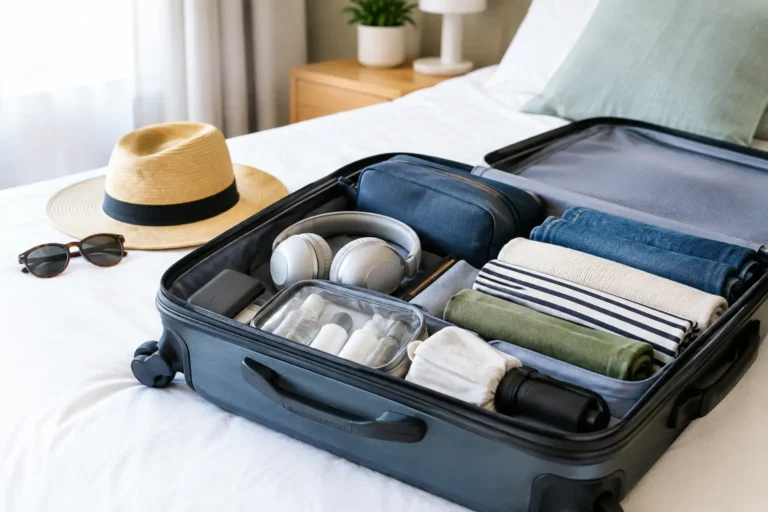
Pack one light layer, loose trousers or a longer skirt, and something that covers your shoulders. They take little room in a bag and remove a lot of stress when you want to enter a mosque, church, temple or shrine. In some settings, covering your head is expected; in others, it is optional. Check before you arrive, then follow the lead of staff and local visitors.
There is a trade-off here. Dressing respectfully does not mean ignoring your comfort, especially in serious heat, or pretending you are from somewhere you are not. Clean, breathable and reasonably modest clothing is usually enough. When in doubt, err slightly smarter than the most casual option.
Learn the small rules around food and drink
A meal is often where travellers either make a connection or accidentally create tension. Start by observing. Are people sharing dishes? Is there a particular hand used for eating? Do people wait for an older guest to begin? Is it normal to leave a little food, or is finishing your plate a sign of appreciation?
Do not panic if you do not know. A polite glance at your host or a quiet question is better than turning dinner into an anxious performance. If you have allergies, dietary requirements or do not drink alcohol, be clear and courteous early on. Carrying the translated names of serious allergens can be genuinely useful, particularly when language is a barrier.
Be careful with broad claims such as “I could never eat that” or jokes about unfamiliar ingredients. You do not have to eat everything offered, and no one should pressure you to do so. But a firm, warm “no thank you” is far better than treating someone else’s everyday food as a stunt for your social media.
Tipping deserves the same research. In the UK, we are used to weighing up service charges and leaving something extra. Elsewhere, a tip may be expected, modest, built into the bill or seen as inappropriate. Check current local guidance rather than assuming American-style percentages apply everywhere.
Respect people, privacy and sacred places
The best travel photographs often happen when you slow down. They do not require putting a camera six inches from a stranger’s face. Ask before photographing people, especially children, market traders, worshippers, Indigenous communities and anyone who may feel unable to say no to a tourist.
A smile and a gesture towards your camera can work when you do not share a language, but accept a refusal immediately. Paying for a product does not buy the right to photograph its seller. Nor does visiting a neighbourhood give you permission to treat residents as scenery.
Religious sites need an extra notch of awareness. Keep your voice down, silence your phone, follow signs about shoes and photography, and do not block entrances while taking pictures. If a ceremony is taking place, stand back unless you have been clearly invited to observe. These are living places of worship, not just free attractions between lunch and your next museum booking.
The same principle applies at memorials, cemeteries and sites connected to conflict or tragedy. A playful pose may get a few likes from friends, but it can look bleakly disrespectful to people with a direct connection to the place.
Watch your body language and public behaviour
Gestures do not travel well. A hand sign that is harmless in Britain can be offensive elsewhere, while pointing, beckoning with one finger or showing the soles of your feet may be impolite in particular cultures. You do not need to move through every interaction terrified of your hands. Just use less dramatic body language until you understand what is normal locally.
Volume matters too. British travellers are not always the loudest people in the room, but a group on holiday can become noticeably noisier after a few drinks. On trains, in residential streets, hotel corridors and small restaurants, match the pace and volume around you. Being enthusiastic about a destination is lovely. Making everyone else listen to it at midnight is not.
Public affection, drinking and smoking are also context-dependent. What feels ordinary in one city can attract unwanted attention or break local rules in another. This is not an argument for fear or judgement. It is practical information that helps you avoid putting yourself, your partner or local people in an awkward position.
Spending money without being patronising
Markets and taxis can make etiquette feel confusing because prices, bargaining and tourist pressure are all involved. In some places, negotiation is expected and can be friendly. In others, it is unusual or inappropriate. Watch a couple of transactions first, ask your accommodation host what is normal, and do not bargain aggressively over an amount that is trivial to you but meaningful to the person selling.
Pay agreed prices promptly. Carry smaller notes where possible. If you want to tip, do it discreetly when that fits local practice rather than making a show of generosity. Respect is not measured by how much cash you wave around.
This also means being realistic about your budget. If a fair price for a local guide, driver or family-run guesthouse stretches it beyond what you can afford, choose a cheaper option rather than trying to grind them down. Travelling smarter is not the same as expecting everyone else to subsidise your holiday.
What to do when you get it wrong
You probably will, at some point. Maybe you enter a shop with shoes on when you should not, use the wrong hand, or take a seat reserved for somebody else. The recovery is refreshingly simple: stop, apologise briefly, correct the behaviour and move on.
Do not become defensive, and do not demand a detailed explanation from the person you have inconvenienced. A sincere “I’m sorry, I didn’t realise” plus a quick adjustment usually says enough. Most people can tell the difference between an honest mistake and someone who thinks local customs are silly.
If you are unsure in a new situation, pause for ten seconds and watch what local people do. That tiny habit is more useful than a hundred travel hacks. It keeps you grounded, makes room for genuine encounters and reminds you why you travelled in the first place: not merely to pass through somewhere different, but to meet it with a bit of care.