What to Pack in Hand Luggage Without Regretting It
Your checked suitcase is somewhere beneath a cargo hold full of other people’s holiday plans. Your hand luggage is what gets you through the next 12 hours if that suitcase takes a detour. Pack it like it matters, because it does.
Knowing what to pack in hand luggage is less about squeezing in every possible comfort and more about covering the things that would be expensive, stressful or genuinely difficult to replace. Passport? Obvious. Prescription medication, a phone charger and one clean outfit? Less glamorous, but far more useful when a tight connection goes wrong.
Start with your airline’s hand luggage rules
Before making a list, check the allowance attached to your actual ticket. Budget airlines are particularly strict: the free bag is often a small under-seat bag, while a larger cabin case costs extra. A bag that fitted on your last flight may not fit this time.
Measure your bag when it is full, not when it is empty and optimistic. Wheels, handles and bulging front pockets count. Also check the weight limit, especially if you are carrying a camera, laptop or walking gear. There is no prize for packing brilliantly if you then have to pay at the gate.
For most trips, a small backpack or soft-sided holdall works better than a rigid case under the seat. It is easier to reach during the flight, easier to squeeze into a baggage sizer and kinder to your shoulders while navigating stations and airport queues.
What to pack in hand luggage first: the non-negotiables
Put the items that cannot safely go in the hold in one easy-to-reach pouch or pocket. This means your passport, travel documents, bank cards, driving licence if you are hiring a car, any required visa paperwork and travel insurance details.
Your phone belongs here too, along with a charging cable and a power bank. Keep the power bank in cabin baggage – airlines generally do not allow spare lithium batteries in checked luggage because of fire risk. Check your airline’s rules if you are carrying larger battery packs, camera batteries or drone equipment.
Medication is another clear cabin-bag item. Carry enough for the full trip plus a small buffer in case of delays, and keep it in its original labelled packaging where possible. This is particularly sensible for prescription medicines, insulin, inhalers, EpiPens and anything you would struggle to source abroad. A copy of your prescription or a doctor’s letter can save awkward explanations at security or the border, especially for controlled medication.
Add a small amount of cash in the currency you need, but do not turn your bag into a travelling cash machine. A backup bank card stored separately from your main wallet is usually more useful. If your wallet goes missing in a taxi, you will be grateful you did not put every payment option in the same place.
Pack for the delay, not just the flight
The smartest hand luggage contains a miniature rescue kit for a delayed or lost checked bag. It does not need to be half your wardrobe. It needs to get you through the first night without panic-buying toiletries in an airport shop.
Pack clean underwear, socks and a spare top. For a beach holiday, add swimwear. For a wedding, work trip or cold-weather break, adjust accordingly – you may need the outfit that matters most rather than a casual T-shirt. A lightweight layer is worth having even if you are heading somewhere hot; aircraft cabins, night buses and overenthusiastic air conditioning rarely respect your destination forecast.
If you wear contact lenses, bring glasses as well. Put a toothbrush, toothpaste, deodorant, a small moisturiser and any essential skincare in a clear liquids bag. Face wipes can feel like a small luxury after an overnight flight, but they are also handy when your connection becomes a six-hour floor-sitting exercise.
There is a trade-off here. Carrying a full change of clothes is sensible when you are checking a bag or flying on a route prone to tight connections. On a two-night city break with only hand luggage, you can skip the duplicate outfit and use that space for the things you will actually wear.
Liquids: keep security simple
At many UK airports, the familiar 100ml liquid limit still applies, even though some airports have introduced newer scanners. Do not assume every airport on your outbound and return journey follows the same rule. Each liquid, gel, cream, paste and aerosol should be in a container of no more than 100ml, and these usually need to fit inside one clear, resealable bag.
That includes obvious items such as shampoo and sun cream, but also mascara, lip gloss, toothpaste, hand sanitiser and some foods. A large bottle that is nearly empty is still likely to be confiscated if the container itself holds more than 100ml.
You can avoid most of this faff with solid alternatives: shampoo bars, bar soap, solid deodorant and powder makeup. Buy water after security, then refill your bottle whenever you can. Keeping your liquids pouch near the top of your bag means you are not unpacking your life on a security belt while a queue builds behind you.
Electronics and flight comforts worth carrying
Long-haul flights and low-cost short-haul flights create different problems, but a few basics work for both. Bring headphones rather than relying on airline ones, even if you are only planning to listen to a downloaded podcast. Download entertainment before leaving home – airport Wi-Fi can be patchy, and mobile data abroad may be slower or more expensive than expected.
A universal travel adaptor is useful if you are changing countries, but remember it will not convert voltage. Most modern phone and laptop chargers handle a range of voltages, while some heat styling tools do not. Check before packing your favourite hair tool for a trip to the US or elsewhere with a different supply.
A lightweight power bank earns its space on almost every trip. So does a charging cable that you have tested recently. The cable at the bottom of a drawer that only works if held at a precise angle is not travel gear; it is a future argument with yourself.
For comfort, think small and realistic: an eye mask, earplugs, a reusable water bottle, lip balm and a warm pair of socks can make a budget flight much more tolerable. A neck pillow helps some travellers and annoys others by taking up too much room. If you never use one on trains, you probably will not suddenly become a neck-pillow person at 35,000 feet.
Keep valuables and fragile items close
Cameras, laptops, tablets, jewellery and anything irreplaceable should travel in the cabin where you can keep an eye on them. This is partly about theft, but mostly about avoiding rough handling and the simple reality that checked bags occasionally disappear for a while.
Use a padded sleeve for electronics and avoid putting heavy chargers against your laptop screen. If you are taking a camera, carry the battery in the cabin and think carefully about how much kit you truly need. A body, two lenses and a tripod might be justified for a photography trip. For a long weekend in Lisbon, your phone may be enough – and you will spend less time guarding a bag in busy bars and trams.
Organise your bag so it works at the airport
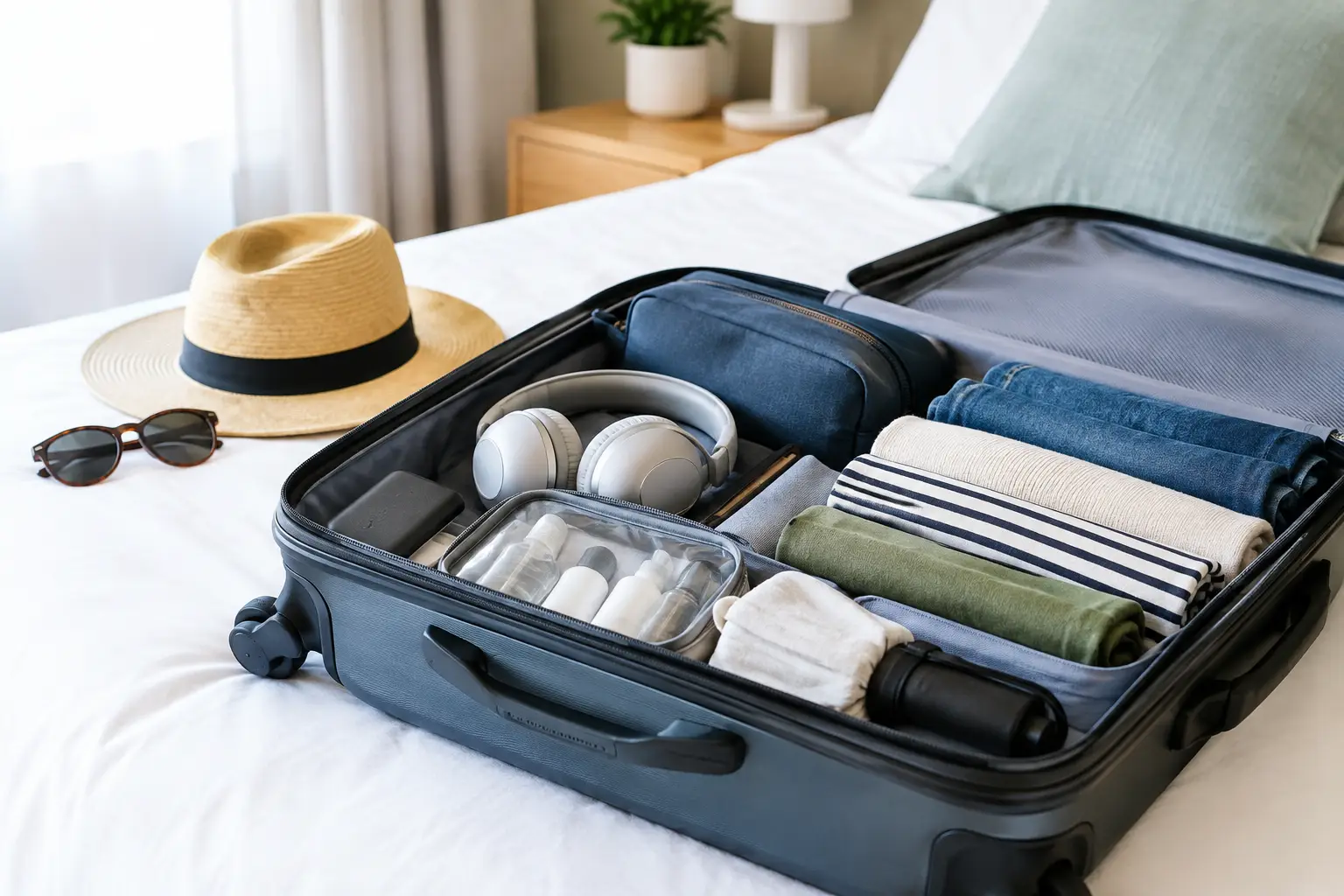
Good packing is not just a checklist. It is being able to find your passport without turning the departure lounge into a crime scene. Keep documents, wallet, phone and boarding pass in one secure place. Put liquids and electronics where security can access them quickly. Put your spare clothes and less urgent items at the bottom.
Packing cubes are useful if they stop your bag becoming a tangled mess, but they are not compulsory. A couple of simple zip pouches can do the same job for cables, medication and toiletries. The goal is fewer loose items, not an Instagram-worthy arrangement.
Leave a little empty space if you can. It gives you somewhere to put a jacket after security, room for a snack, and a fighting chance of repacking if staff ask you to move something around. A hand luggage bag packed to absolute capacity is one delayed flight away from becoming deeply annoying.
A quick final check before you leave
Before heading to the airport, ask one practical question: if your checked bag vanished for 24 hours, would this bag keep you safe, comfortable and able to start your trip? If the answer is yes, you have packed well.
Then weigh it, measure it and remove the things you packed out of habit. The best hand luggage is not the one with the most gear in it. It is the one that lets you walk off the plane ready for whatever the trip throws at you.